// How a Blower Door Test Works
The fan depressurizes the house to 50 Pa. Air rushes in through every gap and crack, revealing the total air leakage rate (ACH50).
Blower Door Testing for BC Builders
Key takeaway: The blower door test is the pass/fail moment in Step Code compliance. Test mid-construction to catch problems early. Budget 1.5 to 2 hours and $400 to $600 for the final test.
This is the practical playbook: what the equipment does, when to schedule the test, how to prep your build, and what a failing result actually triggers. If you want the conceptual deep-dive — the building physics behind depressurization, why 50 Pa is the standard, and how airflow turns into a score — read the companion walkthrough at Blower Door Test Explained. This page stays focused on the decisions you have to make on the ground.
How the Test Works
A calibrated fan mounts into an exterior door frame and depressurizes the building to 50 Pascals, roughly a 30 km/h wind hitting every surface simultaneously. The fan measures airflow volume to maintain that pressure. Airflow divided by home volume gives you ACH50. Lower is tighter.
Here is the plain-English version of why 50 Pa is the benchmark. The fan pulls air out of the house faster than the building can draw it back in through its cracks and gaps. That deficit creates suction, and the technician dials the fan up or down until the inside sits a steady 50 Pa below the outside. Holding the building at that one fixed, repeatable pressure is what makes every test comparable — a tight near-Passive-House build and a leaky shell are both measured against the same yardstick. A leaky house needs a lot of air moved to stay depressurized; a tight house needs very little. That airflow rate is what becomes your ACH50.
The equipment: a variable-speed fan, an adjustable nylon panel that seals the fan into the door opening, and a digital manometer (pressure gauge) that reads the inside-outside pressure difference and the airflow at the same time. Modern rigs run the manometer through software that records the curve automatically.
Standard: CGSB 149.10. Your energy advisor documents results in the as-built compliance report.
Duration: 10 to 15 minutes for the test. 1.5 to 2 hours for a complete visit with diagnostics.
Who Runs the Test
The test is performed by a Registered Energy Advisor (REA) — a third-party professional certified through a service organization licensed by Natural Resources Canada (NRCan). The REA is independent from the builder, and their sign-off is what makes the result count for compliance; a builder cannot self-certify the number.
For Part 9 work the same advisor is usually the through-line of your whole compliance process: they build the energy model before you break ground, run the optional mid-construction test, run the official as-built blower door test, and prepare the EnerGuide and compliance paperwork that goes into your permit file. Because their involvement is effectively required for Steps 2 through 5, the smart move is to engage one early rather than scrambling for a tester at completion. They don’t need to be local to model your drawings — on-site presence is only needed for the actual tests. See our energy advisor guide for how to find and work with one.
ACH50 Targets by Step Level
| Step Level | ACH50 Target | Difficulty |
|---|---|---|
| Step 2 | 3.0 | Standard practice |
| Step 3 | 2.5 | Consistent air barrier detailing |
| Step 4 | 1.5 | Deliberate strategy required |
| Step 5 | 1.0 | Passive House-adjacent |
Step 4 is expected in 2027. The 40% tighter target from 2.5 to 1.5 changes the economics of air sealing entirely. The exact target you need depends on your step and how your energy model is balanced — see our ACH targets guide for the full picture, and how to achieve 1.5 ACH50 if you’re chasing Step 4.
When to Test: Mid-Construction vs Final
A mid-construction blower door test in BC is run after the air barrier is complete but before drywall goes up — it’s the diagnostic test that catches leaks while they’re still cheap to fix. The final (as-built) test is the official compliance test that goes on record. There are two strategic moments, and deciding whether to do both is the single highest-leverage call in this whole process.
Mid-Construction (Recommended)
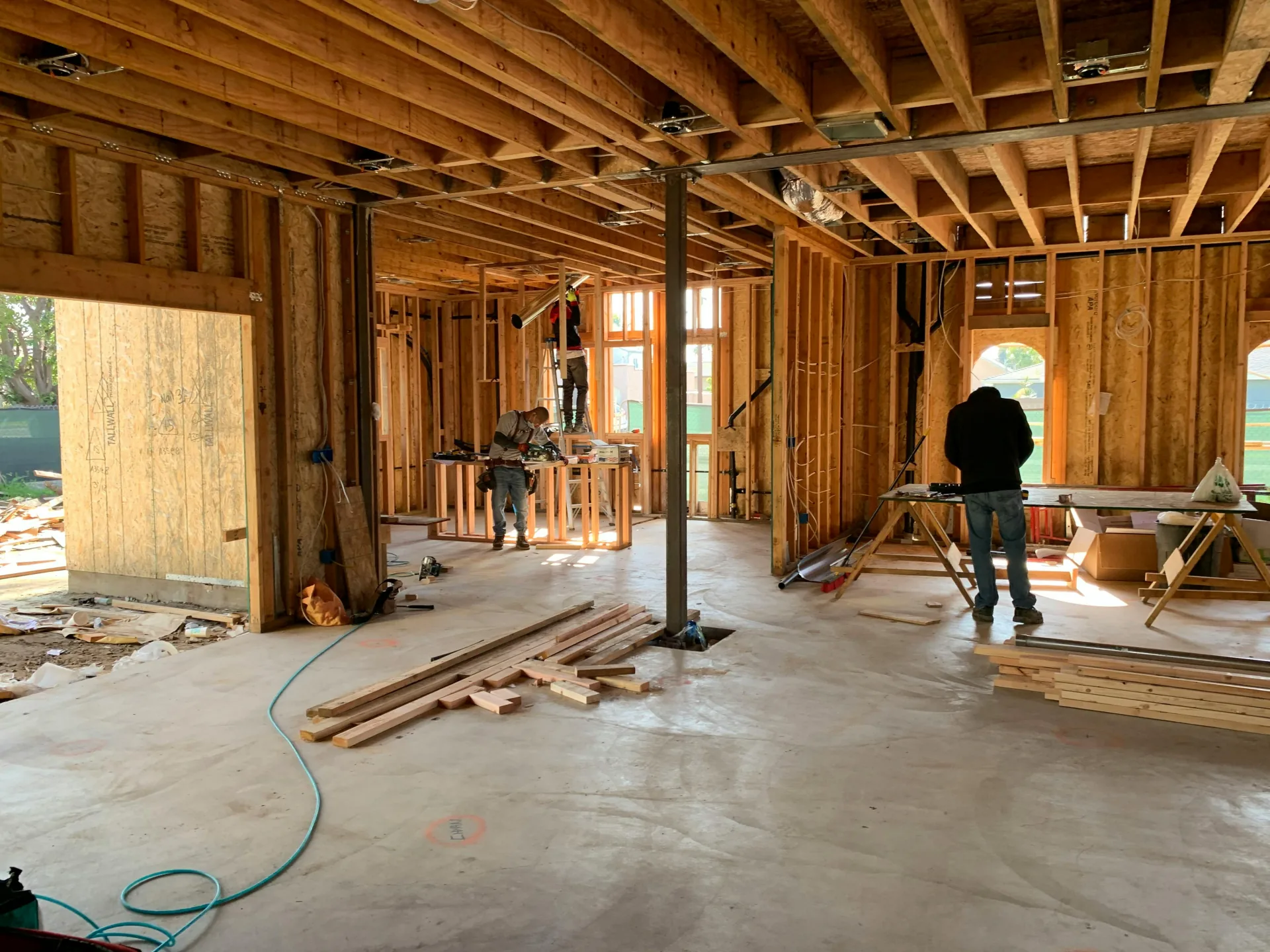
After framing, insulation, and air barrier but before drywall. Every connection is visible and fixable. Builders who test mid-construction pass at significantly higher rates. This test is diagnostic, not official — its job is to find leaks while they are still cheap. With the wall cavities open you can put a hand on a leaking top plate or rim joist, seal it on the spot, and move on. Some AHJs require it before the insulation inspection (Surrey and Abbotsford among them), but even where it isn’t mandatory, energy advisors strongly recommend it for Steps 3 through 5.
Kelowna offers a $325 rebate. Cost: $300 to $500. See our Kelowna Step Code guide for local details.
Final (Required)
After construction, before occupancy. The energy advisor produces the as-built compliance report for the occupancy permit. This is the number that goes on record.
The decision logic is simple. If your target is loose (the lower steps), a clean build and a single final test may be enough. If your target is tight — Step 4, Step 5, or any aggressive ACH50 goal — the mid-construction test stops being optional, because finding a leak at the final stage means tearing into finished walls. Skipping the mid-construction test is the most common reason builders fail the final and face expensive retrofits.
How to Prepare
A blower door test needs the house in a specific state so you measure the permanent envelope, not temporary openings or mechanical paths. The fundamentals start at the design table and run through to test day:
- Design phase: Simpler geometry = fewer transitions. Engage your energy advisor early and plan for common air leak locations.
- Framing: Continuous bottom plate sealant is the single highest-impact detail.
- Air barrier: Continuity is everything. Every seam sealed, every penetration sealed. The early pre-drywall air sealing work is where airtightness is won or lost.
- Before test day: Walk the building. Seal all penetrations: electrical, plumbing, vents, duct connections.
On the day itself, the building should be set up like this:
- Exterior doors and windows closed (but not locked) — you’re measuring real envelope leakage, not an open window.
- Interior doors open, including closets, so the whole conditioned volume tests as one zone and the suction reaches every room evenly.
- HVAC off, exhaust fans and range hoods off with dampers in place.
- Plumbing traps filled with water so the fan doesn’t pull sewer gas through dry traps.
- Fireplace dampers closed, ashes cleaned out, and combustion appliances off or in a safe state.
- Attic hatches, crawlspace access, and rough penetrations addressed — these are classic leak paths.
Your energy advisor will walk you through the full checklist ahead of time. The better prepared the site is, the faster and cleaner the test runs.
Common Mistakes
- Missed bottom plates. Most common leakage source. Acoustical sealant must be continuous.
- Unsealed electrical boxes. Every exterior wall box needs vapour barrier pads or airtight boxes.
- Plumbing penetrations. Consistently missed at second-floor bathroom rough-ins.
- Rim joist areas. Spray foam or rigid insulation with sealant makes a measurable difference.
- Recessed lighting. Use airtight-rated (AT) fixtures, not just IC-rated.
Other repeat offenders worth a walk-through: top plates where the ceiling plane meets the attic, window and door rough openings, attic hatches, and the air-barrier transition where an attached garage meets living space. Knowing the pattern is half the cure — the leaks cluster at penetrations, transitions, and any point where the air barrier was never made continuous.
What to Do If You Fail
A failing number is a problem, not a write-off. Most failures trace to a small set of usual suspects — penetrations, assembly transitions, and sequencing errors — so the fix is usually targeted, not a teardown.
- Diagnostic first. Smoke pen or thermal camera while the blower door runs. Find the biggest leaks. Reviewing your air barrier drawings is also worth a moment — many failures start as design-stage omissions.
- Fix and retest. Many failures become passes within a few hours of targeted work. Re-testing after sealing is standard practice, not a black mark.
- Consider AeroBarrier. Aerosol-based sealing can close the gap post-construction with real-time monitoring. The system pressurizes the house, atomizes a water-based sealant that gets carried to the leak paths, and builds up at each opening — sealing gaps up to about half an inch — while measuring against your target ACH50 live, so it stops when the number is hit. This can take a finished house from failing to passing in a single session.
Retrofitting a finished house is always more expensive than building tight in the first place, which is exactly why the mid-construction test matters so much. The cheapest airtightness work happens before drywall, in the wall assembly detailing and air-barrier continuity decisions made early in the build.
Cost of Testing in BC
| Service | Typical Cost |
|---|---|
| Final blower door test | $400 to $600 |
| Mid-construction test | $300 to $500 |
| Diagnostic session | $200 to $400 |
| Full energy advisory package | $2,500 to $4,000 |
Most builders don’t pay for the blower door test in isolation — it’s bundled into the energy advisor’s fee, which covers pre-construction modelling, the mid-construction review, and the final as-built test and report. Because cost scales with home size and complexity, always confirm the price locally before you budget, and check Step Code requirements by municipality for what your jurisdiction actually mandates.
For more on hitting your target, see our ACH targets guide or Step Code 4 guide.
Frequently asked questions
Do I have to do a mid-construction test, or just the final one? Only the final as-built test is the official compliance test that goes into your permit file. Some municipalities (such as Surrey and Abbotsford) require a mid-construction test before the insulation inspection, but elsewhere it’s diagnostic and not strictly required. For anything beyond the lower steps it is the practical difference between an easy fix and a costly retrofit — the leaks you can seal with open walls become very expensive to reach once drywall is up.
Who is allowed to perform the blower door test for Step Code? For Part 9 residential compliance the test must be run by a Registered Energy Advisor (REA) certified through a Natural Resources Canada service organization. The same advisor typically handles your pre-construction energy modelling, the mid-build test, and the final EnerGuide and compliance paperwork that lands in your building permit record. Builders cannot self-certify the result.
What happens if my house fails the as-built test? A failing number is a problem, not a dead end. You can locate leaks with a smoke pen or thermal camera while the fan runs, seal them, and re-test — re-testing after sealing is normal. If the leaks are buried in finished walls, aerosol sealing can pressurize the house and seal it from the inside in a single session, taking a failing home to passing without opening up assemblies.